---
title: "Application architecture"
---
> Documentation Index
> Fetch the complete documentation index at: https://openarkstudio.github.io/ark/llms.txt
> Use this file to discover all available pages before exploring further.
# Application architecture
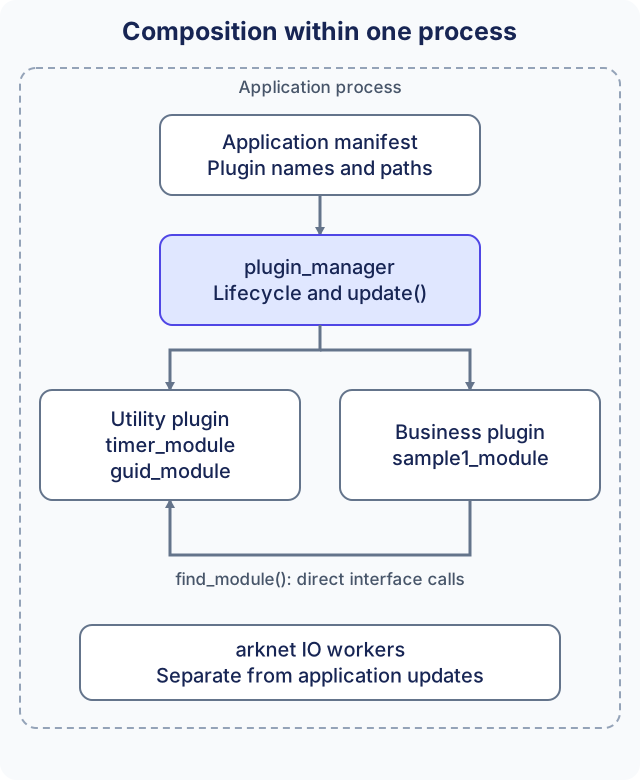
An ark application is a process assembled from selected plugin libraries. A plugin can register several modules, and modules call each other through registered interfaces. Composition happens within the process; communication with another process uses the [Bus and network interfaces](/ark/reference/bus).
## From manifest to modules
The launcher receives `--busid`, `--name` and `--app_conf`. The application manifest chooses shared-library names and optional per-plugin configuration filenames. The shipped `build/conf/sample1.app.conf` is:
```xml
```
New application manifests can use TOML; the equivalent [sample1.app.toml](https://github.com/OpenArkStudio/ark/blob/main/build/conf/sample1.app.toml) is also supplied. A lowercase `.toml` suffix selects TOML, while the legacy `*.app.conf` entry selects XML. See [Application manifests](/ark/guides/service-configuration/application-manifests) for the full schema and validation rules; per-plugin and business-resource formats are unchanged.
The loader loads each library and calls its exported plugin entry. `sample1_plugin::install()` registers `sample1_module`; the utility plugin provides services such as timers. A module resolves those services with `find_module()`, rather than creating another copy of the utility plugin.
The manifest's names are runtime library names. Existing `AFUtilityPlugin` / `Sample1Plugin` names do not follow the C++ class spelling and must match the built artifacts. Debug libraries use the configured `_d` postfix. An empty `conf` supplies no configuration filename; the loader itself does not parse plugin-specific content.
## Paths and a runnable starting point
The existing launcher resolves these paths from its working directory. Library and plugin-configuration prefixes are concatenated with filenames, so retain the trailing separator in `bin/` and `conf/`. The manifest's location does not automatically become the base directory.
After following [installation](/ark/get-started/installation) and preparing the runtime directory, run from `build/`:
```sh
./bin/app --busid=1.0.1.1 --name=sample1 --app_conf=conf/sample1.app.conf
```
The example's `init()` obtains timer and Guid modules; `post_init()` schedules a timer. Its update and shutdown methods demonstrate the module lifecycle. See [sample1_module.cpp](https://github.com/OpenArkStudio/ark/blob/main/examples/sample1/sample1_module.cpp) and the [quick start](/ark/get-started/quick-start) for the runtime setup.
## Choosing the composition
| Application need | Include and initialize |
| --- | --- |
| Local timers or identifiers | Utility plugin and the corresponding module interfaces |
| Schema-backed entities | Kernel and its dependencies, metadata/configuration resources, maps and instances |
| Process messages | Bus/network plugins, process identity and endpoint configuration |
| Application behavior | An application-owned plugin that registers its business modules |
Adding a public header or CMake API target only makes an interface available to compile. Runtime configuration still has to load its owning plugin. Modules do not run in a separate process merely because they are in separate libraries.
## Ordering and ownership
The manager installs plugins before running the module initialization stages. It does not topologically sort module dependencies or make manifest list order a lifecycle-order contract. Missing-module lookups can return null, and module callback return values are not currently aggregated into a transactional startup result. Verify required plugins/resources and application logs; a running process alone does not prove every service initialized successfully.
Pointers returned by `find_module()` belong to the loaded plugin. Stop asynchronous producers before teardown and do not retain those pointers after unload. Keeping connections and state through an in-flight business-plugin replacement is not an automatic consequence of this composition model.
Continue with [framework boundaries](/ark/concepts/architecture), [module implementation](/ark/guides/modules), or [Kernel data](/ark/reference/kernel).
Source: https://openarkstudio.github.io/ark/concepts/application-architecture/index.mdx