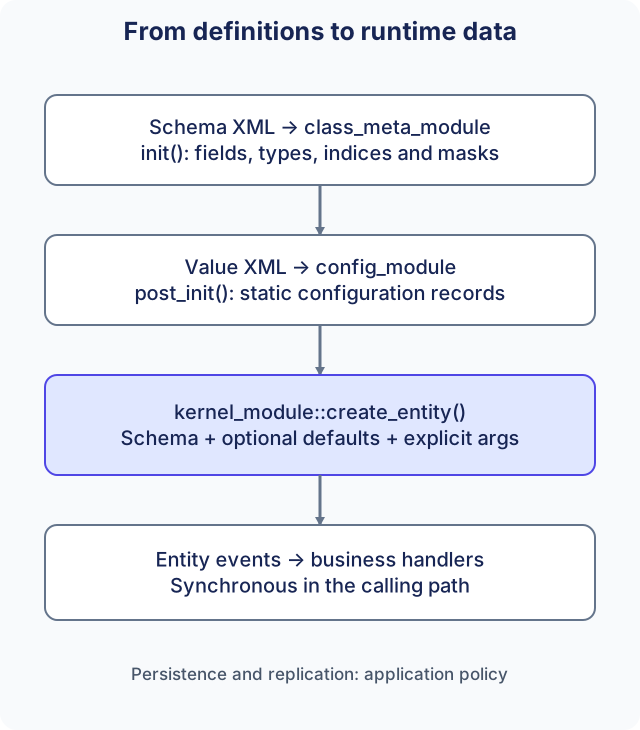
ark separates a class’s schema, reusable configuration records and mutable runtime entities. Business modules use the Kernel interfaces to read or change that data and react to events. Changing a schema does not itself generate business rules, database writes or network replication.
Three different kinds of data
| Kind | Defines or contains | Owner / access |
|---|---|---|
| Metadata | Field names, indices, types, masks, table-row classes and container-child classes | class_meta_module, class_meta |
| Static configuration | Named class records indexed by configuration ID | config_module, static_entity |
| Runtime entity | An entity ID, class, mutable fields, tables and child entities | kernel_module, entity |
Metadata describes what values mean. A configuration ID identifies a reusable record, while an entity ID identifies one runtime object. Multiple entities can start from one configuration without sharing mutable node values. See data structures for the APIs and ownership of each object.
Loading resources
class_meta_module loads resource/meta/config_class.config and resource/meta/entity_class.config during init(). These lists reference schema files; configuration metadata can also reference value resources. config_module loads static records in post_init(), after metadata initialization.
These are paths under resource/ in the process working directory. Legacy references beginning with / are still treated as resource-relative paths. They are business metadata/configuration XML, separate from the application’s plugin manifest. The configuration tool generates resources and C++ metadata indices; generated metadata files must be prepared for a real deployment and are not all supplied as tracked runtime output.
Keep field names, indices, types and generated meta_define.hpp consistent. A C++ naming cleanup does not authorize changing externally stored schema names or protocol field numbers.
Creating an entity with defaults
Entity creation requires an existing class schema, map and map instance. A positive configuration ID must refer to a record of the same class. Configuration provides defaults; explicit initialization arguments take precedence for the same field, including zero and empty values. Unspecified fields keep configuration values.
This example sets Player.level to 0. The caller has already created the map/instance and loaded a matching configuration record:
#include <memory>

#include "ark/kernel/data_list_impl.hpp"
#include "ark/kernel/kernel_module.hpp"
#include "ark/meta_define.hpp"

std::shared_ptr<ark::entity> spawn_player(
    ark::kernel_module& kernel, int map_id, int instance_id, ark::id_type config_id) {
    ark::data_list_impl args;
    args.add_int(0);
    args.add_u_int(ark::entity_meta_player::level_index());
    return kernel.create_entity(
        ark::null_guid, map_id, instance_id, ark::entity_meta_player::self_name(), config_id, args);
}
Arguments are (value, uint32_t field_index) pairs, with exact schema types. Check the returned pointer before using the entity. Invalid schema/map/configuration, duplicate IDs or malformed arguments can fail creation. See Kernel creation and defaults for full examples and the restore-from-Protobuf distinction.
Events and application policy
Defaults and arguments are established before the first creation event, entity_evt_pre_load_data. The ordinary create overload then dispatches its class events synchronously through entity_evt_data_finished. Field/table/container events let modules respond to changes; handlers run in the calling execution path, not on an automatically created business-event worker.
Register handlers before creating the relevant entities, and keep callback owners alive. Callback registration does not currently provide a general public unregister counterpart. Avoid holding pointers across entity/row destruction or modifying shared entity state directly from unrelated IO workers.
Masks describe persistence/synchronization intent, but declaring save, sync_self or sync_view does not configure a database, select recipients or guarantee delivery. The application still decides when to serialize, persist, synchronize and recover state. The Kernel reference documents callbacks and conversion APIs; application architecture explains module ownership.