Use a node for one typed value, a table for rows with a shared schema, and a container for child entities. All three belong to the Kernel data model; their definitions are separate from their runtime values. This guide uses the current snake_case interfaces, not the historical AF-prefixed implementation layouts.
The public Kernel interfaces live in include/ark/kernel/. See configuration tools for generated C++ and Protobuf for protocol messages.
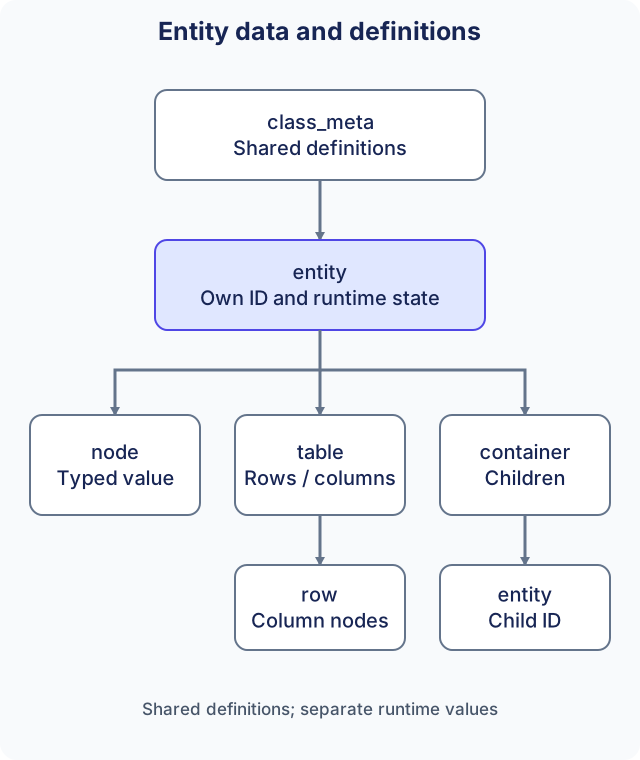
Data definitions
| Definition | Describes | Runtime value |
|---|---|---|
node_meta |
Field name, index, value type and masks | node, accessed through entity or row |
table_meta |
Table name/index, row class and masks | table with row objects |
container_meta |
Container name/index, allowed child class and masks | container holding child entities |
class_meta |
Class name, field-index mapping and the three definition collections | entity or configuration static_entity |
Metadata is shared description, not an entity’s mutable state. A table’s row class describes its columns. A container holds entities with their own IDs; it is not a table row or an untyped map. Choose the structure according to the operations and ownership the application needs.
Find metadata before accessing values
The metadata module loads schema resources during initialization. Check that the class and field exist and use the accessor matching the declared type:
#include <cstdint>
#include <string>

#include "ark/kernel/class_meta_module.hpp"

bool is_int32_field(ark::class_meta_module& schemas, const std::string& class_name, std::uint32_t index) {
    auto schema = schemas.find_meta(class_name);
    if (schema == nullptr)
    {
        return false;
    }
    auto field = schema->find_data_meta(index);
    return field != nullptr && field->get_type() == ark::data_type::dt_int32;
}
entity::get_node_type() checks a runtime field’s declared type. Then use get_int32() / set_int32(), get_string() / set_string() or the corresponding typed accessor. Zero and an empty string are values, not reliable indicators that an entity or field is missing.
Work with tables and rows
A table is created from its declared table metadata. The following function finds or adds one row and writes a known int32 column. The caller supplies schema indices; it does not create a schema or infer a column from the value.
#include <cstdint>

#include "ark/kernel/entity.hpp"
#include "ark/kernel/table.hpp"

bool set_row_value(ark::entity& owner, std::uint32_t table_index,
    std::uint32_t row_index, std::uint32_t column_index, std::int32_t value) {
    auto* table = owner.find_table(table_index);
    if (table == nullptr || table->get_col_type(column_index) != ark::data_type::dt_int32)
    {
        return false;
    }
    auto* row = table->find_row(row_index);
    if (row == nullptr)
    {
        row = table->add_row(row_index);
    }
    return row != nullptr && row->set_int32(column_index, value);
}find_table(), find_row() and add_row() return borrowed pointers. Do not retain a row after remove_row() or clear(), or retain a table after its entity is destroyed. Row IDs and column indices are different identifiers. A nonzero row ID selects a specific row; add_row(0) allocates a row ID. Register table callbacks before mutations when the application needs change notifications.
Work with child entities
entity::find_container(index) returns a container object or null. Use kernel_module::create_container_entity(parent_id, container_index, class_name, config_id) to create a schema-compatible child. Check its return value; the parent, container definition, class and optional matching configuration must exist.
Use container::find(slot) or lookup by child ID to find placement. place() and swap() change placement; remove() and destroy() are distinct operations, so choose according to whether the application intends detachment or destruction. A retained shared_ptr<entity> is not proof that the entity remains registered in Kernel. Re-query its ID when live registration matters.
Configuration and runtime ownership
static_entity is a loaded configuration record. entity adds runtime identity, mutable nodes, tables, containers and event behavior. Ordinary entity creation uses configuration as defaults and preserves explicit initialization arguments; later entity writes do not alter the original configuration record. See data-driven creation.
node_manager, table_manager and container_manager organize the corresponding runtime collections. Applications normally use the public entity/table/container interfaces instead of depending on manager internals or *_impl member layouts. Borrowed pointers and callbacks do not make these objects safe for concurrent mutation from arbitrary threads.
Data configuration generation
The existing configuration tool generates XML metadata, static values and C++ field-index definitions. Keep them consistent when changing a schema. Field masks such as save/synchronization intent require application code to choose persistence and delivery policy; they are not automatic storage or replication.
The Kernel reference provides complete creation, typed access, callbacks and conversion examples. Application architecture explains when the modules are available. Historical AF-prefixed layouts remain in the original source article; those private layouts are not the current API contract.