Intended direction
The original note wanted the data abstraction to represent nested structures rather than only a fixed set of basic value forms. For example, a business record could contain a structure, an array or a keyed collection of other values. This describes a modeling goal; it does not define wire encoding, persistence layout or C++ ownership.
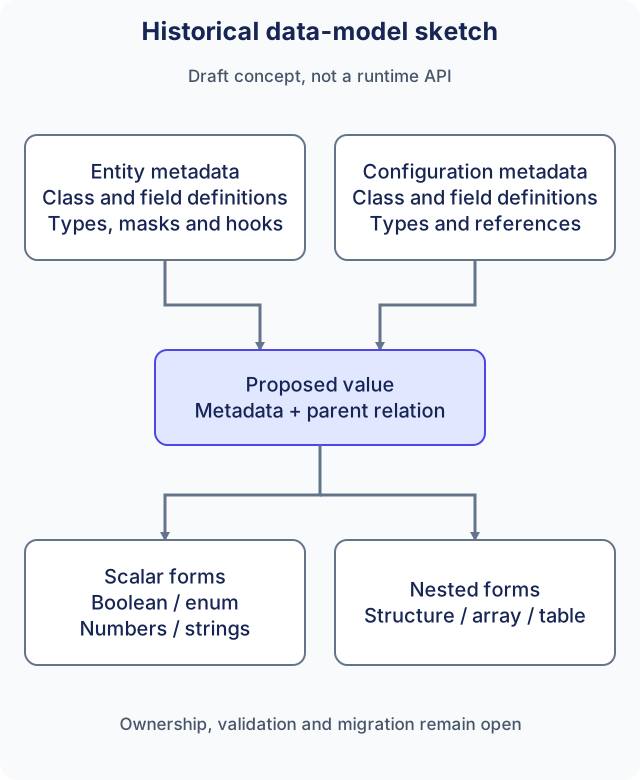
The note also separated runtime entity definitions from reusable configuration definitions and their values:
| Historical filename | Proposed meaning |
|---|---|
EntityClass.meta |
Definitions for runtime instance objects |
ConfigClass.meta |
Configuration record schema, analogous to table columns |
Config.config |
Configuration records using that schema |
These are names in the old proposal. They are not new files required by the current loader. Current resource lists are resource/meta/entity_class.config and resource/meta/config_class.config; see data-driven loading.
Current interfaces and the proposed extension
Current Kernel supports typed entity nodes, schema-backed table rows and containers of child entities. Use those interfaces for present applications. A container of entities is not automatically a general array of arbitrary nested values, and a Protobuf conversion function does not define migration for a future value hierarchy.
A future extension would need to specify type validation, nested references, ownership and removal behavior, change notification, serialization and compatibility. It must also say how class/field indices and existing configuration records map to the new structures. The proposal does not yet supply those rules or a safe reload protocol.
Migration boundary
Keep existing metadata names, generated indices, saved data and external message contracts consistent until a migration has been explicitly designed and tested. Service-process configuration and business data are separate concerns; choosing a service manifest format does not select the representation of these entity/configuration resources.
Use data structures for today’s model and the related design note for the metadata sketch. The Chinese original source is preserved in the source archive; no historical English source is claimed.