An ark application is a process assembled from selected plugin libraries. A plugin can register several modules, and modules call each other through registered interfaces. Composition happens within the process; communication with another process uses the Bus and network interfaces.
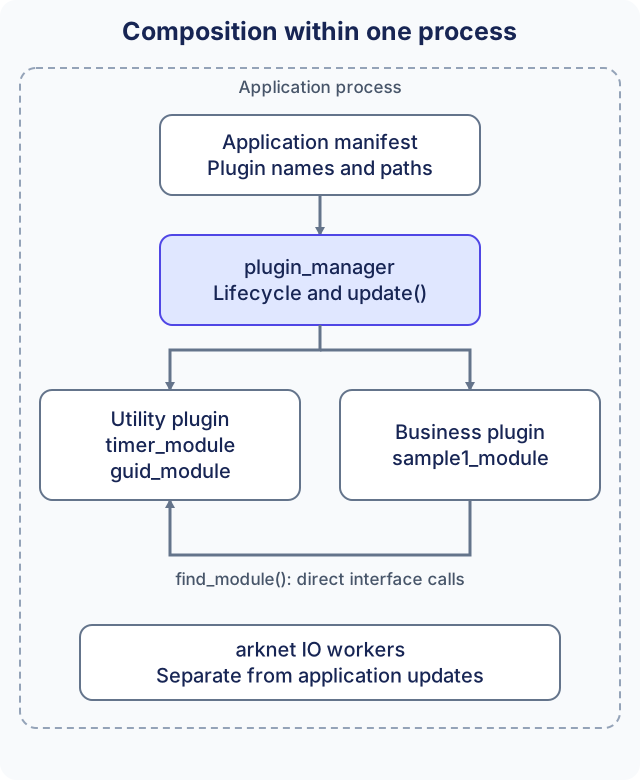
From manifest to modules
The launcher receives --busid, --name and --app_conf. The application manifest chooses shared-library names and optional per-plugin configuration filenames. The shipped build/conf/sample1.app.conf is:
<xml>
    <plugins plugin_lib_dir="bin/" plugin_conf_dir="conf/">
        <plugin name="AFUtilityPlugin" conf="" />
        <plugin name="Sample1Plugin" conf="" />
    </plugins>
</xml>
New application manifests can use TOML; the equivalent sample1.app.toml is also supplied. A lowercase .toml suffix selects TOML, while the legacy *.app.conf entry selects XML. See Application manifests for the full schema and validation rules; per-plugin and business-resource formats are unchanged.
The loader loads each library and calls its exported plugin entry. sample1_plugin::install() registers sample1_module; the utility plugin provides services such as timers. A module resolves those services with find_module<timer_module>(), rather than creating another copy of the utility plugin.
The manifest’s names are runtime library names. Existing AFUtilityPlugin / Sample1Plugin names do not follow the C++ class spelling and must match the built artifacts. Debug libraries use the configured _d postfix. An empty conf supplies no configuration filename; the loader itself does not parse plugin-specific content.
Paths and a runnable starting point
The existing launcher resolves these paths from its working directory. Library and plugin-configuration prefixes are concatenated with filenames, so retain the trailing separator in bin/ and conf/. The manifest’s location does not automatically become the base directory.
After following installation and preparing the runtime directory, run from build/:
./bin/app --busid=1.0.1.1 --name=sample1 --app_conf=conf/sample1.app.confThe example’s init() obtains timer and Guid modules; post_init() schedules a timer. Its update and shutdown methods demonstrate the module lifecycle. See sample1_module.cpp and the quick start for the runtime setup.
Choosing the composition
| Application need | Include and initialize |
|---|---|
| Local timers or identifiers | Utility plugin and the corresponding module interfaces |
| Schema-backed entities | Kernel and its dependencies, metadata/configuration resources, maps and instances |
| Process messages | Bus/network plugins, process identity and endpoint configuration |
| Application behavior | An application-owned plugin that registers its business modules |
Adding a public header or CMake API target only makes an interface available to compile. Runtime configuration still has to load its owning plugin. Modules do not run in a separate process merely because they are in separate libraries.
Ordering and ownership
The manager installs plugins before running the module initialization stages. It does not topologically sort module dependencies or make manifest list order a lifecycle-order contract. Missing-module lookups can return null, and module callback return values are not currently aggregated into a transactional startup result. Verify required plugins/resources and application logs; a running process alone does not prove every service initialized successfully.
Pointers returned by find_module() belong to the loaded plugin. Stop asynchronous producers before teardown and do not retain those pointers after unload. Keeping connections and state through an in-flight business-plugin replacement is not an automatic consequence of this composition model.
Continue with framework boundaries, module implementation, or Kernel data.