Local Results
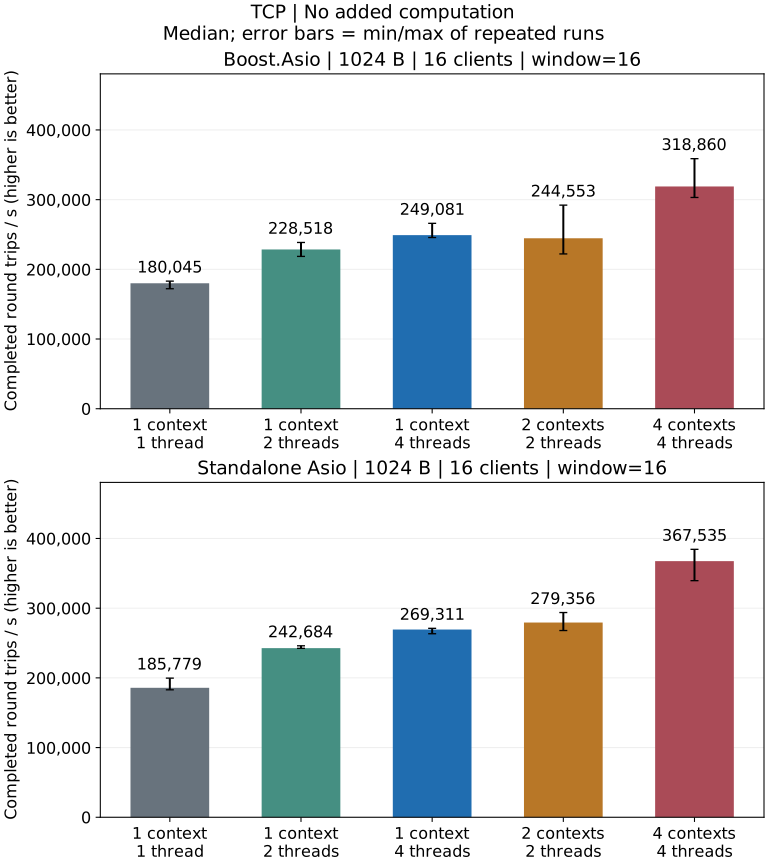
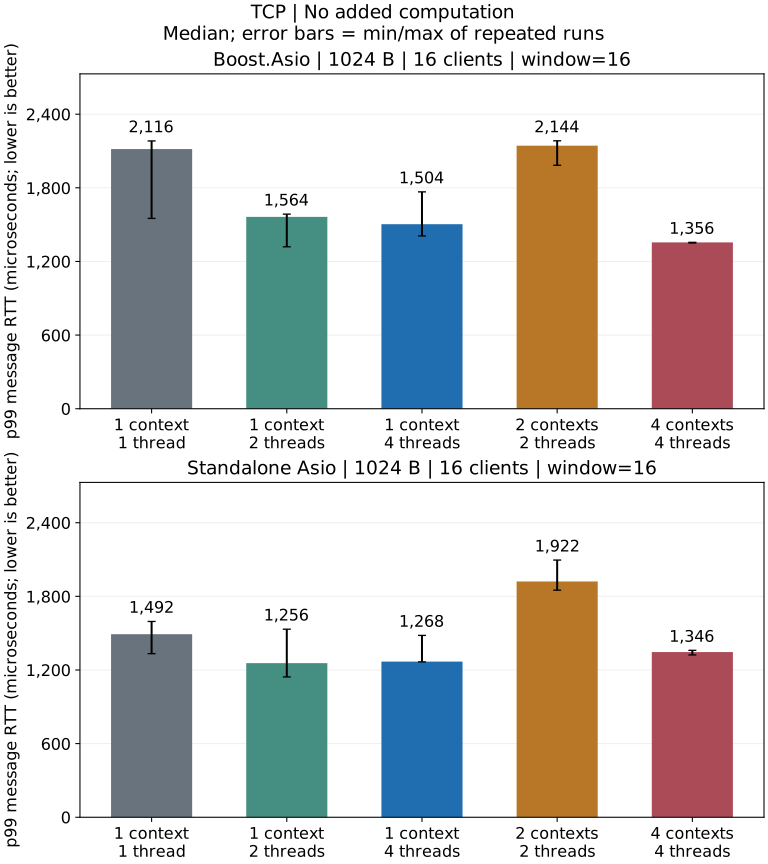
Release local loopback: 1024-byte messages, 16 clients, window 16 and no extra application computation.
What This Run Shows
- Four contexts/one thread each has the highest throughput median for both dependency combinations.
- The lowest p99 median belongs to one context/two threads for standalone and four contexts/one thread each for Boost.
- With one client and window 1, one context/four threads has lower throughput medians than one context/one thread for both dependency combinations.
Complete TCP report · Test environment · Metrics and statistics
Payload, batch and execution comparisons
Build and Compare IO Models
Run from the repository root with a Release build. Replace the Asio include path
with -DARKNET_USE_BOOST_ASIO=ON for the Boost dependency combination, keeping other settings
and hardware unchanged.
Commands assume a single-configuration generator. With Visual Studio, add
--config Release to the build command and run the executable under
benchmarks/Release/. Windows executables end in .exe.
cmake -S . -B build-perf -DCMAKE_BUILD_TYPE=Release \
  -DARKNET_BUILD_BENCHMARKS=ON -DARKNET_ENABLE_SSL=OFF \
  -DARKNET_USE_BOOST_ASIO=OFF -DARKNET_ASIO_INCLUDE_DIR=/path/to/asio/include
cmake --build build-perf --target arknet_loopback_benchmark arknet_coroutine_benchmark --parallel 3
build-perf/benchmarks/arknet_loopback_benchmark \
  --protocol tcp --payload 1024 --clients 16 --window 16 \
  --io-model shared --io-threads 1 --work 0 --warmup 0.25 --seconds 1
This single configuration uses 1024-byte messages, 16 clients, window 16 and
one context/one thread. It writes one JSON result to standard output. Change
--io-threads to 2 or 4 for a shared context, or use --io-model sharded --io-threads 4 for four contexts/one thread each. --work 10000 adds 10,000
deterministic iterations per server echo; 0 adds no application computation.
These iterations do not represent a real parser or application. Repeat each
configuration three times in fresh processes; the complete shell matrix is in
Testing.
Native Asio Coroutine Scheduler
build-perf/benchmarks/arknet_coroutine_benchmark \
  --execution coroutine --protocol tcp --payload 1024 --clients 16 --window 16 \
  --io-model shared --io-threads 1 --work 0 --warmup 0.25 --seconds 1
The Asio coroutine benchmark program uses awaitable/co_spawn and fixed-size
TCP batches; see the coroutine report and
IO models. A public arknet coroutine endpoint API is deferred.
With window greater than one it reports batch RTT, unlike the callback program’s
message RTT, framing and replenishment rules; compare thread models within each
program. --execution callback runs the matched native callback mode; both
native modes use the same batch protocol.
The TCP callback test uses use_dgram framing and does not cover unframed
streams, connection establishment rate or real request handlers. Short loopback
runs do not establish cross-host capacity, WAN latency or endurance.
See testing and report metadata, callback benchmark source and coroutine source.