Local measurements on 2026-10-12 include 504 matrix runs, 21 receive-buffer isolation runs, and a 60-second UDP stress run for each dependency configuration. Independent Release C++ programs produced these results, not CI.
Test Conditions
| Item | Configuration |
|---|---|
| Machine | Mac mini Mac16,11, Apple M4 Pro, 14 cores (10 performance + 4 efficiency), 48 GiB |
| OS | macOS 27.0.1 (26A434), arm64, AC power, low-power mode disabled |
| Toolchain | Apple Clang 21.0.0, CMake 4.3.3, Ninja, C++20, Release -O3 -DNDEBUG |
| Dependencies | Standalone Asio 1.38.2 / Boost 1.90.0, OpenSSL 3.6.4; TLS build enabled, sanitizers disabled |
| Network | IPv4 loopback; clients and server in one process; no CPU affinity |
| Measurement | Three independent processes per configuration; 1 s measurement, 0.25 s warmup; isolation runs have no warmup |
| Socket buffers | 64 KiB send / 4 MiB receive; isolation runs vary the server receive capacity |
Matrix source SHA-256: 0771574af8ca56f1914deb544b956079e0a2f24021953ded5f5d524e3df334b1. Isolation runs add server receive counts and a configurable receive buffer; their archive includes the patch and executable hash.
Correctness and Load Range
| Group | Standalone | Boost | Result |
|---|---|---|---|
| UDP stress | 60 seconds passed | 60 seconds passed | Data and shutdown checks passed in these runs |
| IO models: 3 payloads × 2 client counts × 5 models | 90 / 90 passed | 90 / 90 passed | Window-1 performance baseline |
| Payload / batch: 3 payloads × 4 windows × 3 models | 93 / 108 passed | 93 / 108 passed | 62 valid configurations and 10 failed configurations combined |
| Size boundaries: 6 payloads × 3 windows | 36 / 54 passed | 36 / 54 passed | Large bursts exceed receive capacity |
All failed records remain archived. A failed repetition excludes all three runs of that configuration from throughput rankings.
Throughput and Latency
1024-byte datagrams, 16 clients, one outstanding message per client, no extra computation:
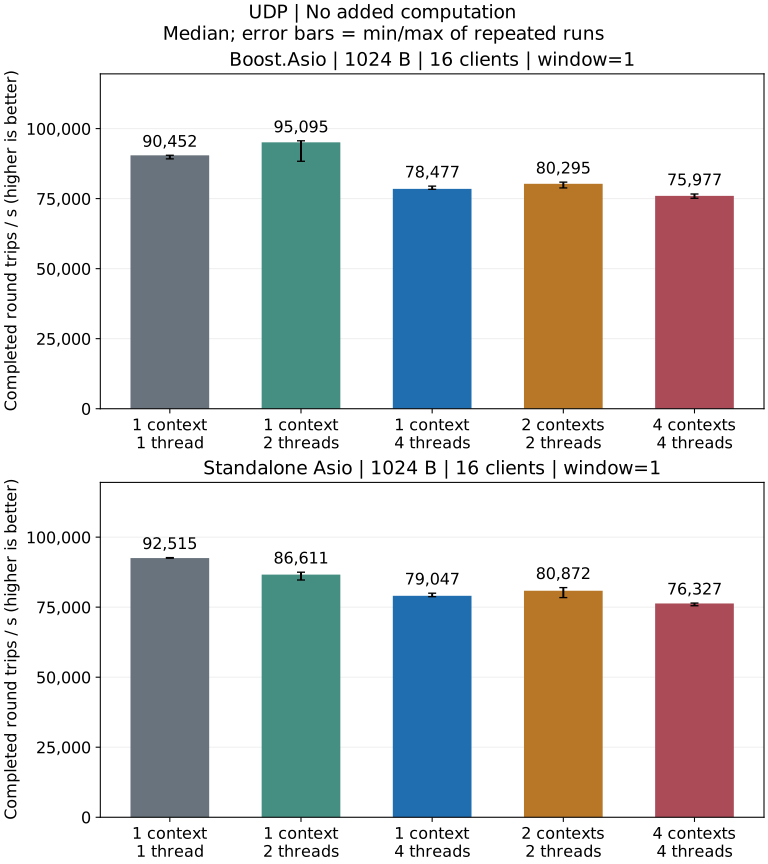
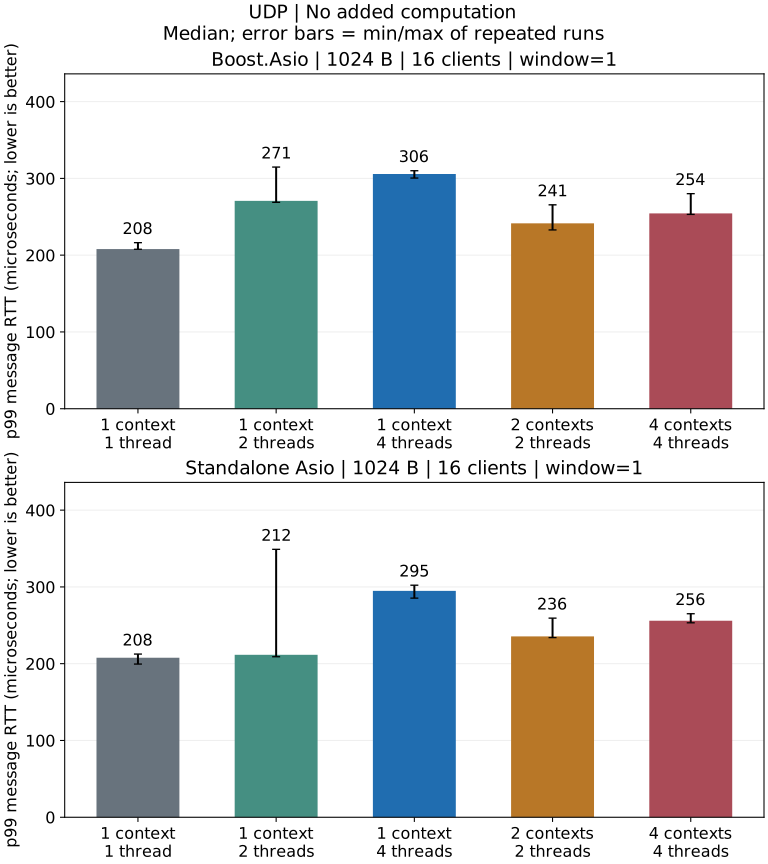
| Dependency | io_contexts / threads | Roundtrips / s | p99 RTT / μs | Process CPU / % |
|---|---|---|---|---|
| Standalone | 1 / 1 | 92,515 | 207.79 | 99.4 |
| Standalone | 1 / 2 | 86,611 | 211.58 | 173.3 |
| Boost | 1 / 1 | 90,452 | 207.96 | 99.7 |
| Boost | 1 / 2 | 95,095 | 270.71 | 157.4 |
Standalone has the highest median throughput with one thread at this load. Boost gains some throughput with two threads, at higher p99 latency and CPU use.
Bars show medians; error bars show the minimum and maximum of three runs, not confidence intervals. CPU uses one core as 100% and includes both clients and server. Whole-machine share is process CPU% / 14.
All IO values · Complete 64/1024/16384-byte results · Payload and outstanding-window charts
Receive Buffer Isolation
16 clients, one context/one thread, no warmup. Each configuration runs three times; loss counts below are identical across the three repetitions.
| Payload / B | Outstanding per client | Effective server receive buffer | Total outstanding payload budget | Loss per run |
|---|---|---|---|---|
| 16,384 | 64 | 1 MiB | 16 MiB | 959 |
| 16,384 | 64 | 2 MiB | 16 MiB | 895 |
| 16,384 | 64 | 4 MiB | 16 MiB | 767 |
| 16,384 | 16 | 4 MiB | 4 MiB | 0 |
| 16,384 | 1 | 4 MiB | 256 KiB | 0 |
| 1,472 | 64 | 4 MiB | 1.44 MiB | 0 |
| 1,024 | 1,024 | 4 MiB | 16 MiB | 12,411 |
Every run satisfies: client sends − server receives = missing datagrams; server receives = client echoes. Content and sequence errors are zero. In one 4 MiB / 16 KiB / window-64 run, the kernel’s dropped due to full socket buffers counter increased from 152,304 to 153,071: exactly 767. IPv4 fragmentation/reassembly increases were zero.
See Buffers and flow control for configuration and the TCP/UDP distinction. Native UDP datagram semantics remain unchanged: no new default throttling, fragmentation or retransmission.
Reproduce and Inspect Evidence
Compile using the UDP build instructions, then directly run the C++ case:
build-perf/benchmarks/arknet_loopback_benchmark \
  --protocol udp --payload 16384 --clients 16 --window 64 \
  --io-model shared --io-threads 1 --seconds 1 --warmup 0 \
  --udp-server-receive-buffer 4194304
This overflow probe is expected to return a nonzero status. Set the window to 16, or the payload to 1472, to reproduce the corresponding loss-free configurations above.
Raw records, commands and machine metadata · Per-run kernel snapshots · Size-boundary charts
Results cover short IPv4 loopback runs on this machine. Cross-host capacity and IPv6 stress capacity are not measured. RUDP has a separate report. Coroutine comparisons use native TCP and must not be generalized to UDP.