Local TCPS Results
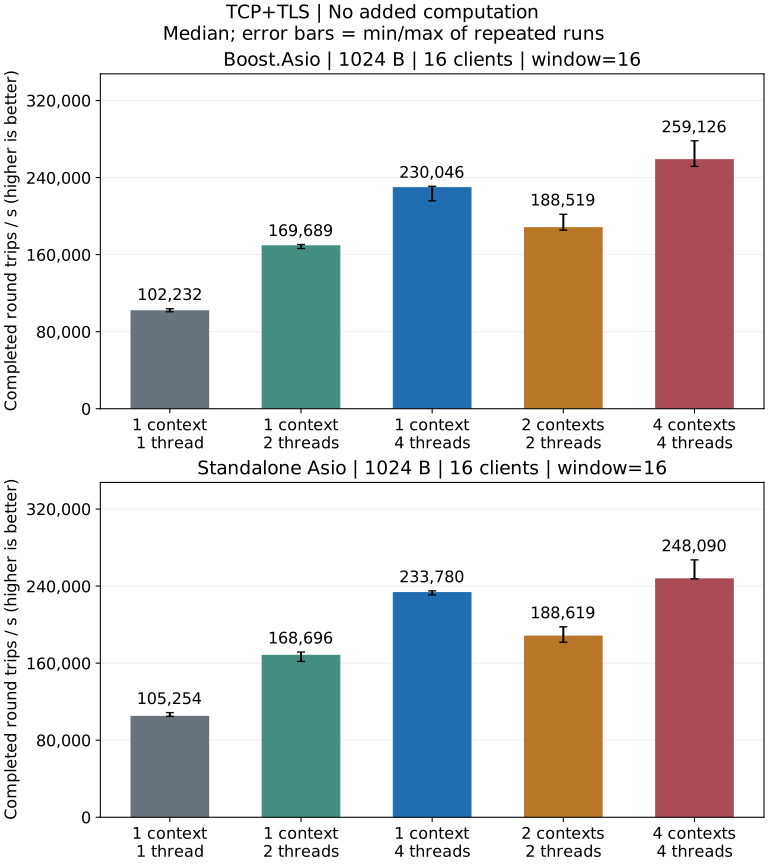
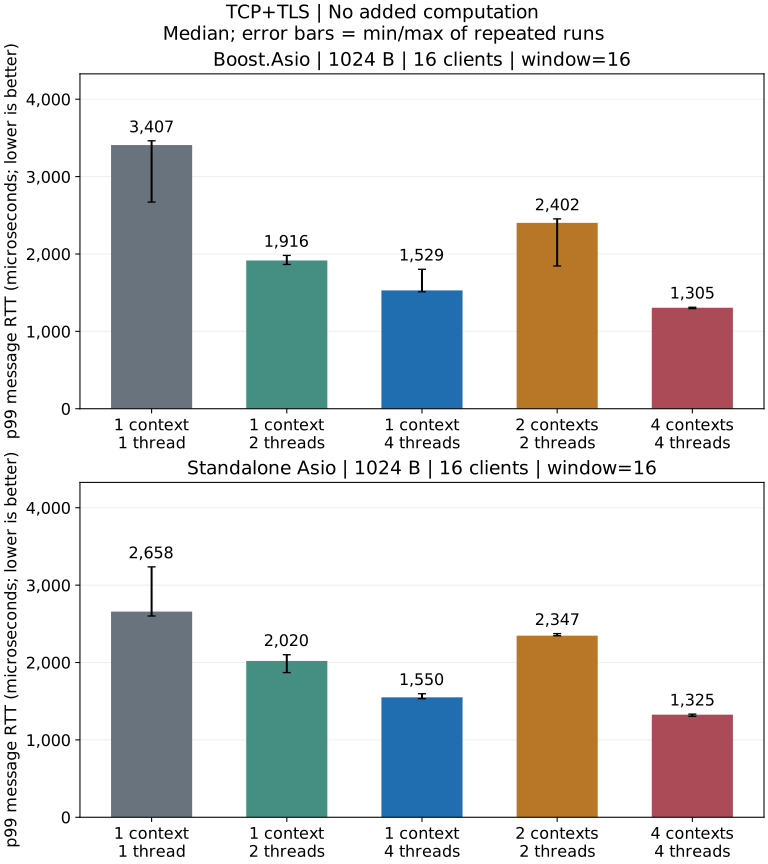
Release local loopback after TLS handshake: 1024-byte messages, 16 clients, window 16 and no extra application computation.
What This Run Shows
- Four contexts/one thread each has the highest throughput median and lowest p99 median for both dependency combinations.
- With one client and window 1, one context/one thread has the best throughput and p99 medians for both dependency combinations. The benefit of extra threads depends on concurrency.
Complete TCPS report · WSS report · HTTPS report
Test environment · Metrics and statistics
Payload, batch and execution comparisons
Build and Reproduce
Use a Release build from the repository root. Replace the standalone include
argument with -DARKNET_USE_BOOST_ASIO=ON for Boost. Both dependency combinations must use the
same OpenSSL version, host and build options for a meaningful comparison.
Commands assume a single-configuration generator. With Visual Studio, add
--config Release to the build command and run the executable under
benchmarks/Release/. Windows executables end in .exe.
cmake -S . -B build-perf-tls -DCMAKE_BUILD_TYPE=Release \
  -DARKNET_BUILD_BENCHMARKS=ON -DARKNET_ENABLE_SSL=ON \
  -DARKNET_USE_BOOST_ASIO=OFF -DARKNET_ASIO_INCLUDE_DIR=/path/to/asio/include
cmake --build build-perf-tls --target arknet_loopback_benchmark --parallel 3
for repetition in 1 2 3; do
  for protocol in tcp tcps websocket wss http https; do
    build-perf-tls/benchmarks/arknet_loopback_benchmark \
      --protocol "$protocol" --certs tests/certs \
      --payload 1024 --clients 16 --window 16 \
      --io-model shared --io-threads 1 --work 0 --warmup 0.25 --seconds 1 \
      > "build-perf-tls/${protocol}-${repetition}.json" || exit 1
  done
done
This loop collects three fresh-process measurements per plaintext/TLS protocol,
using 1024-byte messages, 16 clients, window 16 and one context/one thread,
saving each result separately. Change --io-threads to 2 or
4 for a shared context, or use --io-model sharded --io-threads 4 for four
contexts/one thread each. --work 10000 adds 10,000 deterministic iterations per
echo; 0 adds no application computation. The complete shell matrix is in
Testing. Encryption for one connection still
executes through its serialized lane.
The server uses the test certificate/key and the client trusts its test CA, verifying the chain and IP identity. Public certificates are for local testing; mTLS correctness is covered separately by TLS tests.
Compare TCP/TCPS, WebSocket/WSS or HTTP/HTTPS with matching message size,
concurrency, computation, dependency combination and thread model. TCP uses use_dgram,
WebSocket uses binary frames, and HTTP uses persistent connections.
The test excludes handshake rate, connection churn, session resumption, certificate rotation, cipher-suite and mTLS throughput; JSON does not record the negotiated cipher suite. End-to-end differences include parsing and encryption, and steady-state loopback results do not establish churn capacity or cross-host capacity.
See IO models and benchmark source.